

What Is a Corset Saree? Complete Guide for 2026

Green and blue tissue jamewar ombre corset pre-draped saree by Chamee and Palak — the silhouette redefining Indian eveningwear.
The corset saree is the silhouette quietly rewriting what Indian eveningwear looks like in 2026. Where the traditional saree relied on the choli — a fitted blouse, often short, structured but rarely shaped through the torso — the corset saree replaces it with a constructed bodice that does real architectural work on the body. The result is a piece that reads as evening couture and South Asian heritage in the same breath, which is exactly why it has become the most-requested silhouette across cocktail evenings, sangeets, and modern bridal wardrobes.
If you have been seeing corset sarees across wedding feeds, designer drops, and bridal editorials and wondering what to call them, where the silhouette came from, and how to wear one well — this is the guide.
The Corset Saree, Defined
A corset saree is a saree ensemble where the traditional blouse is replaced by a structured corset bodice — typically boned, often with built-in support, and shaped through the bust, waist, and rib to create the defined silhouette associated with classical eveningwear. The saree itself can be draped traditionally over the corset, or — increasingly — supplied pre-draped, with the pleats and pallu already stitched in place.
What makes the silhouette distinctive is the relationship between the corset and the drape. The corset gives the upper body a sharp, sculpted line — closer to a couture evening gown than to a conventional saree blouse. The drape, whether traditional or pre-stitched, then flows from the corset's bottom edge with the fluidity sarees are known for. The combination is precisely what makes a corset saree photograph the way it does: structured above, liquid below, and instantly recognisable as something more considered than a standard saree.
Where the Corset Saree Came From
The corset saree did not appear overnight. Its emergence belongs to a longer story of Indian designers reinterpreting traditional silhouettes for a generation of women raised on global eveningwear. Designers like Tarun Tahiliani and Sabyasachi began pairing structured bustiers with sarees in their bridal couture more than a decade ago. The silhouette stayed in the couture lane for years — accessible only at the highest price points and largely associated with brides.
The shift in 2024 and 2025 was the silhouette's migration into ready-to-wear and contemporary designer collections. A generation of younger designers — Juhi Bengani, Nidhika Shekhar, Chamee and Palak, Quench a Thirst, Zoon Tribe, Paulmi and Harsh, Ankita Bajaj, Parul Gandhi — began offering corset sarees at occasion-wear price points, with construction sharp enough to honour the silhouette's couture origins. The corset saree became something a wedding guest could realistically buy and wear, not just admire in a bridal editorial.
The Anatomy of a Corset Saree
Understanding the components helps you shop with intention rather than guesswork.
The corset is the defining piece. Construction quality varies considerably — a well-made corset uses internal boning, multiple layers of fabric, and structured shoulder or strap detailing to hold its shape. A poorly made corset will buckle, gape, or roll at the edges. This is the single most important element to assess before buying, because no amount of beautiful embroidery saves a corset that does not fit correctly.
The drape is where designers express movement and fabric. Traditional drapes give the wearer full control over the pleating and pallu. Pre-draped or pre-stitched constructions take the guesswork out — the pleats are already set, the pallu is already arranged, and the saree slips on rather than being wrapped. For first-time saree wearers and international customers, pre-draped is often the more reliable route.
The fabric determines the mood. Organza brings transparency and a slightly stiffer, sculptural drape — well-suited to white, ivory, and pastel colourways. Satin saturates colour and reads as evening cocktail dressing. Georgette flows softly and works across daytime and evening occasions. Net and sequinned fabrics push the piece firmly into nightwear and reception territory.
Embellishment ranges widely. Cutwork, embroidery, sequins, mirror work, and floral appliqué all appear across the corset saree category. The interplay between corset embellishment and drape embellishment is what designers spend the most time on — a heavily embellished corset usually pairs with a quieter drape, and vice versa.
Corset Saree for Daytime and Soft Evening Occasions
Not every corset saree is built for the same moment. The fabric weight, palette, and embellishment density together signal what time of day and what kind of function the piece is built for. Lighter fabrics in white, ivory, nude, and pastel tones lean toward daytime ceremonies, intimate brunches, soft-lit cocktail evenings, and destination-wedding welcome events. The corset construction still does its sculpting work, but the overall mood reads gentler — closer to summer eveningwear than statement cocktail dressing.

Daytime sculpture
White embroidered organza pre-draped saree — the corset silhouette in its cleanest, daytime-leaning expression. Engagement parties, garden ceremonies, daytime cocktails.

Soft cocktail
Nude and gold georgette pre-draped saree — the cocktail-evening piece for guests who want the corset silhouette in a softer, more transitional palette.
Corset Saree for Cocktail Evenings and Sangeets
This is the territory where the corset saree silhouette earns its case most decisively. Cocktail evenings and sangeets sit in the lower-lit, more ambient end of the wedding calendar, and saturated colours hold beautifully under that lighting. Satin drapes — fluid, deeply pigmented, and built to catch light without being weighed down by heavy embroidery — are the natural fabric choice. The corset itself becomes the focal point of the look, and the drape acts as architecture around it. This is also where the silhouette's couture origins read most clearly — pieces in this category genuinely could pass as international eveningwear, with the saree drape as the only signal of South Asian heritage.

Sangeet saturated
Green pre-draped satin saree — jewel-tone saturation that holds under ambient lighting, with a corset structure built for movement on a dance floor.

Cocktail confident
Orange organza pre-draped saree — confident colour, structured organza drape, and the kind of corset construction that photographs as eveningwear first.
Corset Saree for Reception and Statement Evening Wear
At the most formal end of the spectrum sit the corset sarees built for receptions, late-night cocktails, and the moments in a wedding calendar where the dress code is essentially black-tie with an Indian inflection. Net, sequinned, and heavily embellished pieces in deeper or more dramatic palettes — black, deep red, oxblood, midnight blue, gold — dominate this category. The corset embellishment becomes denser, the drape often picks up corresponding work, and the overall effect is closer to red-carpet eveningwear than to traditional saree dressing. These are pieces built to photograph at scale, hold their presence across a long evening, and earn the cost of construction.

Reception statement
Black sequinned net cutwork saree with corset — the corset silhouette at its most distinctly evening, built for receptions and late-night cocktails.
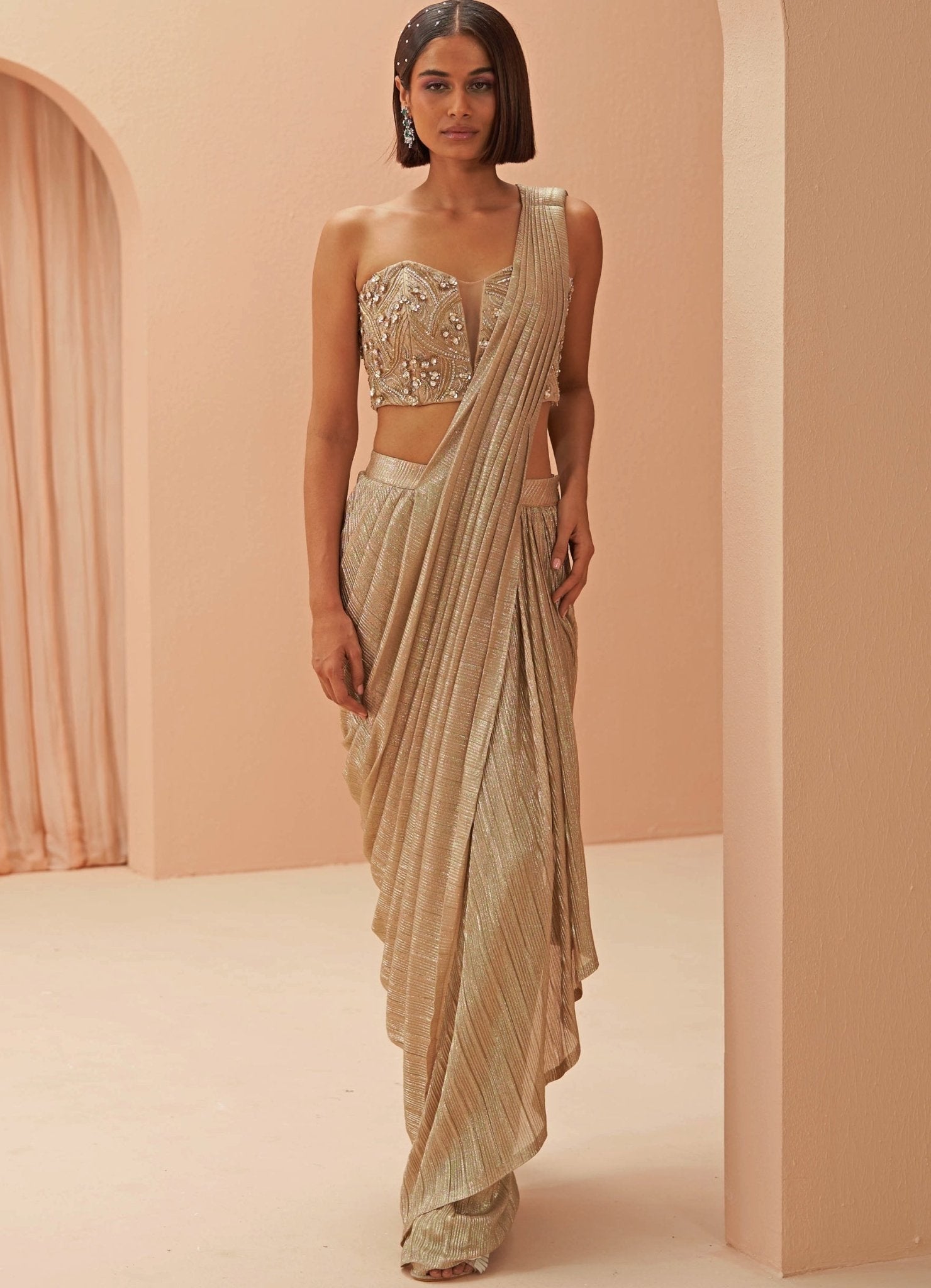
Gold formal
Gold glam draped saree set with corset — the formal eveningwear interpretation of the silhouette, suited to receptions, gala-style functions, and end-of-night statement moments.
How to Style a Corset Saree Well
The principle behind styling a corset saree is to let the silhouette lead and the accessories follow. The corset is doing significant architectural work on the body — the neckline, the shoulder line, the waist definition are all visible and considered. Layering heavy neck jewellery over a structured corset usually competes rather than complements; statement earrings, a sculptural cuff or kada, and minimal or no neck piece is the more disciplined choice.
The drape direction matters more than with a traditional saree. Pre-draped pieces have the drape arranged by the designer, but you should still consider where the pallu falls — a single-shoulder pallu reads modern, a two-shoulder drape reads more ceremonial. Footwear should disappear, not announce. A heeled mojari, a closed-toe pump, or a delicate strappy heel keeps the line clean. Hair pulled back or up usually photographs better with a corset saree than loose hair, because it lets the neckline and shoulder construction breathe.
The Fit Question: Why Corset Sarees Are Less Forgiving
The corset is the least forgiving garment in the South Asian wardrobe of off-the-rack sizing. A 1cm difference in bust, waist, or rib measurement changes how the corset reads on the wearer — gaping at the bust, buckling at the rib, riding up at the waist. Standard size charts work for many garments; they rarely work for a structured corset.
This is why made-to-measure construction, with measurements taken correctly, makes a disproportionate difference for this silhouette specifically. It is also why a video-call consultation — where someone walks you through measuring exactly the right points — is genuinely worth booking before ordering a corset saree internationally. The construction time is longer; the fit outcome is meaningfully better.
Why Custom Sizing Matters Most for Corset Sarees
At Fabilicious, we offer made-to-measure construction with a video-call consultation for measurements — and the corset saree is the single silhouette where customers tell us most often that the consultation was worth booking. Corsets are constructed in layers, with boning and internal support that responds directly to how the measurements are taken. We walk you through where the tape sits, how tight it should be, and where the corset's structural points need to align.
The pairing of South Asian craftsmanship — the karigars, embroiderers, and corset-makers whose work this silhouette depends on — with European quality control means each piece is inspected before it leaves us. For a garment as fit-sensitive as a corset saree, that layer of vetting is what separates a piece that works on the body from one that does not.
FAQ
What is a corset saree?
A corset saree is a saree ensemble where the traditional blouse is replaced by a structured corset bodice — typically boned, shaped through the bust and waist, and built to create a defined silhouette. The saree drape can be traditional or pre-stitched. The result is a piece that combines the sculptural quality of evening couture with the heritage of South Asian dressing.
Is a corset saree the same as a pre-draped saree?
Not exactly — they overlap but are not identical. A pre-draped saree refers to the drape being pre-stitched rather than wrapped. A corset saree refers to the blouse being a structured corset rather than a conventional choli. Many modern designs are both — pre-draped sarees with corset blouses — but you can also find pre-draped sarees with conventional blouses, or corset blouses paired with traditional drapes.
Can a corset saree be worn as a wedding guest?
Yes — the corset saree is currently one of the most popular wedding-guest silhouettes for cocktail evenings, sangeets, and receptions. Lighter fabrics in pastels and whites suit daytime functions, while satin and net pieces in jewel tones or deeper palettes are built for evening occasions. Avoid red, ivory, and gold for the wedding ceremony itself unless the bride has explicitly invited those colours.
Why are corset sarees harder to fit than traditional sarees?
The corset is a structured, boned garment that responds directly to precise measurements through the bust, waist, and rib. A standard saree blouse has more flexibility — it can be slightly loose or slightly fitted without compromising the look. A corset cannot — it either fits correctly or it buckles, gapes, or rolls. This is why made-to-measure construction matters disproportionately for this silhouette.
Where can I buy a corset saree online?
Fabilicious carries a curated edit of corset sarees from designers including Juhi Bengani, Nidhika Shekhar, Chamee and Palak, Quench a Thirst, Zoon Tribe, Paulmi and Harsh, Ankita Bajaj, and Parul Gandhi. Browse the full corset saree collection, with made-to-measure construction, video-call fit consultations, and international shipping.
Shop the Corset Saree Collection
- Curated corset sarees from Juhi Bengani, Nidhika Shekhar, Chamee and Palak, and more
- Made-to-measure construction with video-call fit consultations
- International shipping with European quality control


Leave a comment