
What Makes a Modern Saree in 2026? Trends Explained

The modern saree isn't one silhouette — it's a set of trends quietly reshaping what the saree can be.
The modern saree isn't a single silhouette or a single fabric. It's a category that's been quietly redefined over the past five years by four parallel shifts — the rise of pre-stitched draping, the move from stiff to fluid fabrics, the elevation of the blouse from afterthought to centrepiece, and the increasingly confident conversation between the saree and Western tailoring. Together, these trends have changed who wears sarees, when they wear them, and how. This guide is the reference point for what a modern saree actually looks like in 2026 — and the trends shaping where it's headed.
How the saree has changed: a short context
For most of its history, the saree was defined by its fabric — the silk weight, the regional weave, the embroidery tradition. The drape was assumed; the blouse was a supporting character; the silhouette was unchanging. What's shifted in the last decade isn't the saree's place in Indian wardrobes, which has only grown, but the structural assumptions around it. Pre-stitched draping has made the saree accessible to wearers who don't have a mother or grandmother to pleat it for them. Fluid fabrics like georgette, organza, and chiffon have replaced heavier silks for everything except the most traditional ceremonies. Blouses have become as visually significant as the saree itself. And designers like Moledro, Jade by Ashima, and Paulmi & Harsh have pushed silhouettes that genuinely sit between Indian and Western dressing.
The result is a category that now serves a much broader range of occasions — destination weddings, cocktail receptions, indo-fusion events, modern bridal — and a much broader range of wearers. Below are the four trends that define a modern saree for women in 2026.
Trend 1: The pre-drape movement
The single biggest shift in saree dressing of the past decade is the rise of pre-stitched draping. Originally a runway concept used by designers showing internationally — where models couldn't be expected to drape a saree on the fly — pre-drape has become the default format for anyone shopping a saree as ready-to-wear. The saree arrives stitched, pleated, and structured; the wearer steps into it like a gown.
This is more significant than a convenience upgrade. Pre-drape has expanded the saree's audience to include first-time wearers, second-generation diaspora buyers, and anyone getting ready in a hotel room without an experienced helper. It's also let designers play with structure in ways traditional draping couldn't accommodate — sculpted gowns, sheer overlays, and concept silhouettes that read as eveningwear as much as Indian dress. Moledro's red embroidered pre-drape and ivory-gold floral gown saree are textbook examples of how concept-led pre-drape has moved from runway curiosity to wearable mainstream.

Concept · Pre-Drape
Red Pre-Draped Georgette Saree
Moledro's red pre-drape — concept silhouette, structured embroidery, the format that brought pre-stitched draping into mainstream eveningwear.
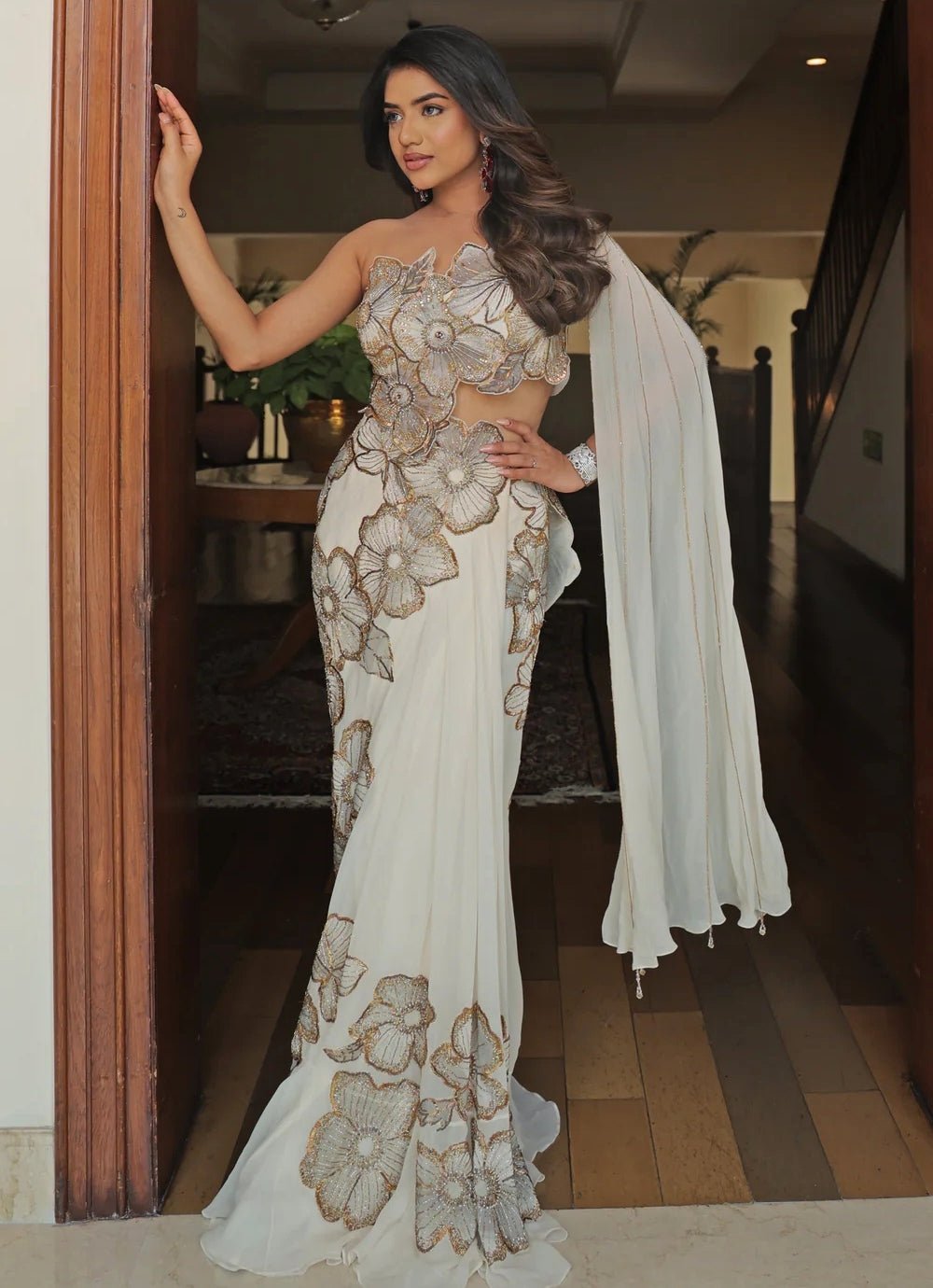
Gown · Floral
Ivory & Gold Floral Gown Saree
A gown-saree hybrid by Moledro — ivory and gold floral, draped and stitched as a single sculpted silhouette.
Trend 2: Fluidity and movement
The second defining trend of the modern saree is fabric weight. The traditional bridal saree weighs between two and four kilograms; a contemporary georgette or organza saree weighs under a kilo and drapes with significantly more movement. This shift hasn't replaced silk — silk remains essential for ceremonial bridal wear — but it's made the saree wearable for occasions where heavier weights simply didn't work. Cocktails, destination weddings, sangeets, dance-led functions, summer receptions.
The ruffle saree is the clearest expression of this trend. Tiered georgette catches movement in a way that flat-draped silk never could; pleats that ripple under stage lighting photograph distinctly; and the silhouette suits both formal occasions and the increasingly fluid party-led events that make up modern wedding wardrobes. Pre-stitched ruffles like Seema Thukral's electric blue and Chamee N Palak's tori pink combine the fluidity trend with the pre-drape trend — two of the four shifts in a single piece.

Ruffle · Movement
Electric Blue Pre-Draped Ruffle Saree
Seema Thukral's electric blue ruffle — tiered georgette with real movement, pre-stitched for ease of wear.

Soft · Pre-Stitched
Tori Pink Pre-Stitched Saree
Chamee N Palak's tori pink pre-stitched — soft, fluid, structured to drape beautifully without traditional pleating.
Trend 3: The statement blouse era
For most of the saree's modern history, the blouse was a supporting piece — coordinated, simple, often quite literally a "blouse piece" stitched in matching fabric. That's changed completely. The contemporary blouse is increasingly the visual centrepiece of the look — embroidered, structured, sculpted, sometimes corseted. Designers like Paulmi & Harsh have built entire collections around the premise that the blouse should do as much work as the saree.
This shift matters because it's changed the styling logic of the entire outfit. A statement blouse anchors the saree; a structured corset blouse turns a fluid drape into a piece that reads bridal or cocktail-formal; a tissue-detailed blouse adds dimension to a clean silk drape that would otherwise read minimal. Champagne tissue, black georgette, and intricately constructed bustiers are the silhouettes leading this trend — and they pair beyond the saree itself, often with lehenga skirts and palazzo pants for receptions where the wearer wants the same blouse to do double duty.

Tissue · Statement
Champagne Tissue Pre-Draped Saree
Seema Thukral's champagne tissue — the saree as backdrop, the blouse as centrepiece.

Black · Sculpted
Black Pre-Draped Georgette Saree
Paulmi & Harsh's black pre-drape — fluid drape anchored by a sculpted, considered blouse silhouette.
Trend 4: Indo-fusion and the bustier era
The fourth defining trend is the saree's increasingly confident conversation with Western tailoring. The bustier-saree, the cape-saree, the corset-saree — all silhouettes that take the saree's drape and pair it with a tailoring vocabulary borrowed from eveningwear. Five years ago these were divisive on Indian aesthetic forums; today they're the most photographed silhouettes at urban Indian weddings, particularly receptions and cocktails.
What's interesting about this trend is how clean it has become. Early indo-fusion sarees often felt like compromises — neither fully traditional nor fully modern. The current generation of designers like Jade by Ashima and Seema Thukral have refined the silhouette to the point where a bustier-saree reads neither costume nor confused — it reads modern. The Orange pre-draped ruffle organza by Jade by Ashima and the ivory pre-stitched set by Seema Thukral are both examples of indo-fusion handled with restraint, where the bustier or fitted top works *with* the drape rather than fighting it. For occasion-specific guidance on these silhouettes, our destination wedding saree edit covers how cape and bustier sarees travel.

Bustier · Indo-Fusion
Orange Pre-Draped Ruffle Organza Saree
Jade by Ashima's orange organza pre-drape — bustier-saree silhouette handled with restraint, indo-fusion at its cleanest.

Ivory · Refined
Ivory Pre-Stitched Saree Set
Seema Thukral's ivory pre-stitched set — a fitted top and pre-draped silhouette working as a single, considered piece.
Where the modern saree sits now — and where it's headed
The four trends above don't operate in isolation. The most interesting modern saree pieces of 2026 combine two or three of them at once — a pre-stitched ruffle saree with a sculpted blouse; an indo-fusion bustier built around a fluid georgette drape; a concept gown-saree that reads equally as eveningwear and Indian dress. This convergence is the real signal of where the category is going. The modern saree is increasingly designed to do more than one job — to work for a sangeet and a cocktail, a destination wedding and a city reception, a function in Mumbai and a function in Manchester.
What this means for the wearer is simpler than it sounds. The most rewearable, most photographed, and most appropriate sarees for 2026 are the ones that sit thoughtfully across these four trends — light enough to travel, structured enough to photograph, modern enough to feel current, traditional enough to honour the occasion. Our complete pre-draped saree edit spans the silhouettes covered here, and our guide to dressing for Indian weddings as a guest covers how these silhouettes work across functions.
Why choose Fabilicious for the modern saree
Fabilicious is a Europe-based platform curating Indian designerwear for modern wardrobes — built specifically for clients buying a modern saree that has to travel, photograph well, and earn its place beyond a single function. Our edit reflects close working relationships with the designers shaping these four trends — Moledro's concept-led pre-drapes, Seema Thukral's ruffle and tissue silhouettes, Paulmi & Harsh's sculpted blouses, Jade by Ashima's indo-fusion silhouettes, and Chamee N Palak's pre-stitched architecture. Every piece is selected for fabric, construction, and rewearability across multiple occasions.
We support international clients with measurement guidance, made-to-measure fit, and video-call styling sessions before purchase. Shipping is supported across the US, UK, Canada, Australia, and the Middle East — with timing built around your wedding or function dates rather than your purchase date.
FAQ
What is a modern saree?
A modern saree is a contemporary interpretation of the traditional saree, defined by four major trends — pre-stitched draping, lighter and more fluid fabrics, statement blouses, and indo-fusion silhouettes. The modern saree is built for ease of wear, movement, and rewearability across multiple occasions.
What is the difference between a traditional saree and a modern saree for women?
A traditional saree is unstitched and draped manually, typically in heavier silks, with a coordinating blouse as a supporting piece. A modern saree for women is often pre-stitched, made in lighter fabrics like georgette or organza, and frequently designed around a statement blouse, corset, or bustier as the centrepiece of the look.
Are pre-draped sarees still considered traditional?
Pre-draped sarees are a contemporary format that has become widely accepted across modern Indian and diaspora wardrobes. While they differ structurally from a traditionally draped saree, they retain the visual silhouette and cultural significance of the saree, and are appropriate for almost all modern wedding functions and cultural events.
Which fabric is most associated with the modern saree?
Georgette, organza, and tissue are the three fabrics most associated with the modern saree. All three drape fluidly, photograph beautifully, and pack well for travel — qualities that align with how modern sarees are increasingly worn at destination weddings, cocktails, and indo-fusion events.
Can I wear a modern saree to a traditional Indian wedding?
Yes — modern sarees are entirely appropriate for traditional weddings, particularly for guests, sangeets, and receptions. For the most traditional ceremonies (mandap, pheras, family rituals), heavier silks remain the conventional choice, but pre-draped, fluid, or blouse-led modern sarees work for every other function in the wedding wardrobe.
Find your modern saree
- Curated sarees — pre-drapes, ruffles, statement blouses, indo-fusion
- Made-to-measure support across the US, UK, Canada and Australia
- Designer pieces built to rewear across multiple occasions
The modern saree isn't a single trend — it's the convergence of pre-drape, fluidity, blouse-led design, and indo-fusion silhouettes into a category that does more for more occasions. The most rewearable pieces of 2026 sit thoughtfully across all four shifts.


Leave a comment