
What Is a Sharara Suit

Ivory and gold embroidered pure silk tissue sharara set by Sanya Gulati — the silhouette at its most considered.
There is a particular kind of pause that happens when a woman walks into a room wearing a sharara. It is the swish of wide-legged silk against the floor. It is the lift of a dupatta caught in motion. It is the deliberate, almost cinematic way the silhouette announces itself before she does.
The sharara suit has been having a quiet renaissance — favoured by brides who want something more spirited than a lehenga, by wedding guests who refuse to wear yet another anarkali, and by a generation rediscovering the heritage tucked into their mothers' wardrobes. If you have found yourself drawn to the shape but unsure of what to call it, where it comes from, or how to wear it well, this is the guide.
The Sharara, Defined
A sharara suit is a three-piece ensemble traditionally consisting of a kurta (a tunic, usually knee-length or longer), a pair of flared, wide-legged trousers that fall in dramatic volume from the knee or thigh, and a dupatta — the long, draped scarf that completes nearly every classical South Asian look.
What distinguishes the sharara from its sister silhouettes is the trouser itself. Cut close at the waist and hip, then released into a generous flare partway down the leg, the sharara creates the illusion of a long skirt while preserving the ease of trousers. The result is a garment that moves beautifully, photographs exquisitely, and — crucially — allows you to dance through a sangeet without stepping on your own hem.
A Brief and Glamorous History
The sharara's origins trace back to the courts of Awadh in northern India during the eighteenth and nineteenth centuries, where it was the favoured attire of Lucknawi nobility. Worn by Nawabi women for celebrations, mushairas, and weddings, the silhouette became synonymous with refinement and unhurried elegance.
For decades after Partition, the sharara held its place as a wedding-day staple in Pakistani and North Indian Muslim families, often reserved specifically for the bride's nikah or the groom's family welcoming the bride home. Bollywood revived its glamour periodically — most memorably through the songs and styling of the nineties and early aughts — and a new generation of designers has now brought it firmly back into contemporary bridal and occasion wear.
Sharara, Gharara, Lehenga: Telling Them Apart
These three silhouettes are frequently confused, and even seasoned shoppers blur the lines. Here is how to read them at a glance.
A lehenga is a long, flared skirt worn with a separate blouse (the choli) and a dupatta. It is a two-piece silhouette where the skirt sits at the waist and falls in panels, gores, or circular cuts to the floor.
A gharara is a closer cousin to the sharara, but the flare is constructed differently. A traditional gharara is fitted from the waist down to the knee, where an ornate horizontal band — the gota — joins the upper trouser to a pleated, voluminous lower section that fans out to the floor. It is heavier, more ceremonial, and considered the most formal of the three.
A sharara sits between them. The trouser flares smoothly from the upper thigh or knee without the structured gota join of a gharara, giving it a softer, more flowing line. It is paired with a kurta rather than a short choli, which makes it both more modest in coverage and more versatile in occasion. If a lehenga is a ballgown and a gharara is a ceremonial robe, the sharara is the perfectly tailored evening trouser suit of the South Asian wardrobe.
The Anatomy of a Sharara Suit
Understanding the components helps you shop with intention rather than guesswork. The kurta is the focal point and the canvas for most of the embellishment — from a streamlined straight cut that grazes the knee to a heavily flared kalidar that mimics a short anarkali. Fabric choices like georgette, silk, organza, net, chanderi, and tissue determine both the drape and the formality of the finished look.
The sharara trousers carry the silhouette. The flare can begin at the knee for a more dramatic, skirt-like effect, or higher up the thigh for a softer cascade. Volume is achieved through pleating, panelling, or circular cuts, often lined with a contrast inner layer to give the fabric body. The dupatta is the punctuation — length, weight, and how it is draped change the entire mood, from a modern single-shoulder drape to a ceremonial two-shoulder veil.
Embellishment is where designers express themselves. Zari work, gota patti, zardozi, sequins, mirror work, and digital prints all live within the sharara tradition. The choice between hand-embroidery and machine work is the single biggest determinant of price and longevity.
Sharara for Mehendi and Haldi: Lighter Fabrics, Daytime Palettes
The mehendi and haldi sit in the daytime end of the wedding calendar, and the silhouette demands lighter fabrics that catch natural light without weighing the wearer down. Georgette and shimmer fabrics in pastels, citrus tones, or fresh florals photograph beautifully against outdoor henna settings and garden ceremonies. These are the pieces where movement matters most — there will be dancing, sitting cross-legged on cushions, and hours of being on your feet. The sharara silhouette earns its place here precisely because it offers the romance of a long skirt without restricting any of that.
 Haldi-ready
Yellow georgette kurta sharara set — celebratory but unweighted, with the kind of movement that suits an outdoor haldi or daytime mehendi function.
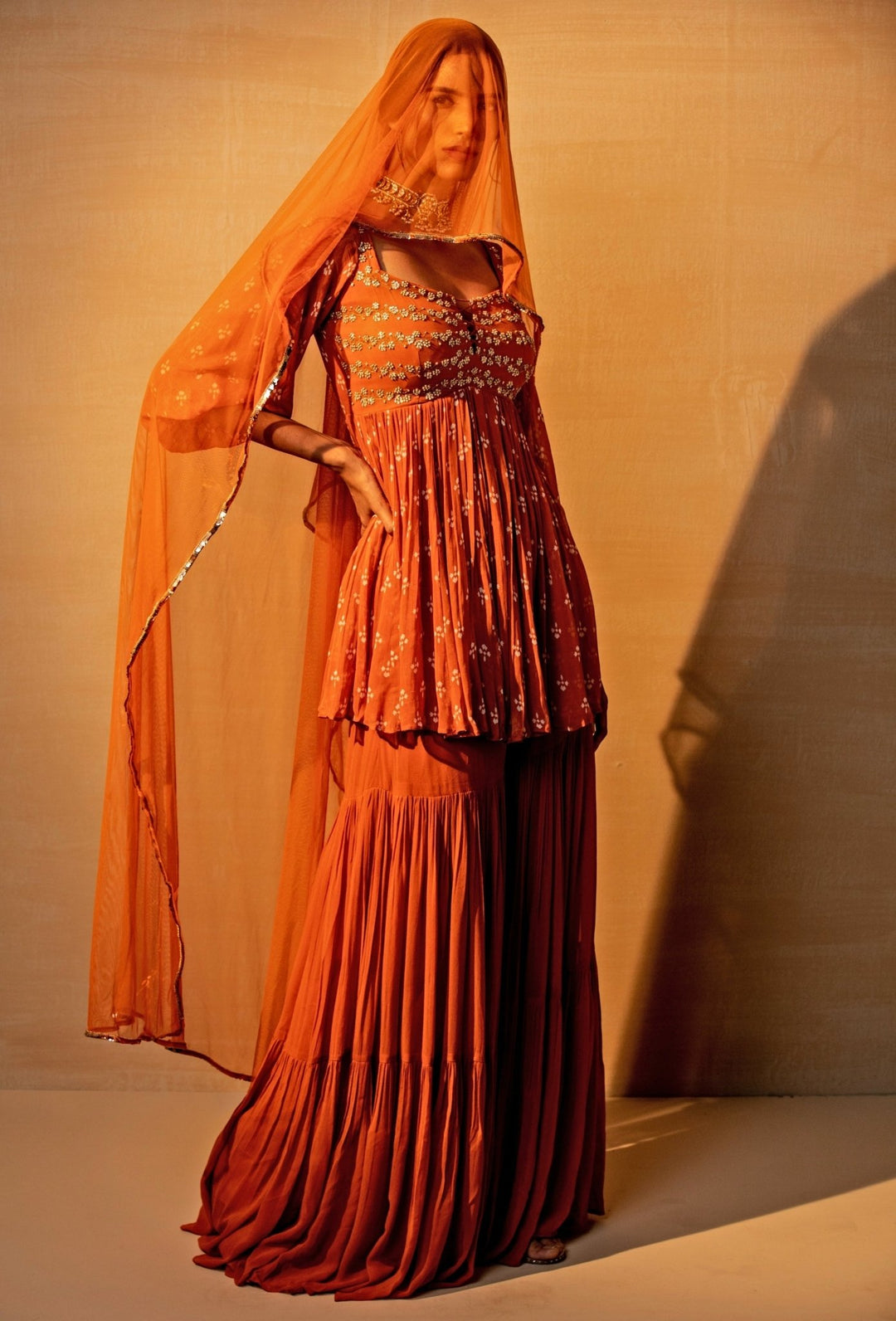
Daytime print
Rust orange printed georgette sharara — print discipline that reads designer rather than decorative, ideal for a daytime ceremony or destination welcome event.
Sharara for Sangeet and Cocktail Evenings: Where the Silhouette Outperforms a Lehenga
This is where the sharara genuinely earns its case against a lehenga. The trouser construction frees you to move through choreography, and the dupatta can be draped or pinned without coming undone mid-routine. Embellished georgettes and shimmer silks in jewel tones work well — saturated enough to hold their colour under low ambient lighting, light enough to dance in for hours. The sangeet is also the most photographed function of most weddings, and the sharara silhouette is one of the most photogenic in motion.

Sangeet evening
Teal blue embroidered georgette — a jewel tone that holds beautifully under evening lighting, paired with embroidery considered enough to photograph well in motion.
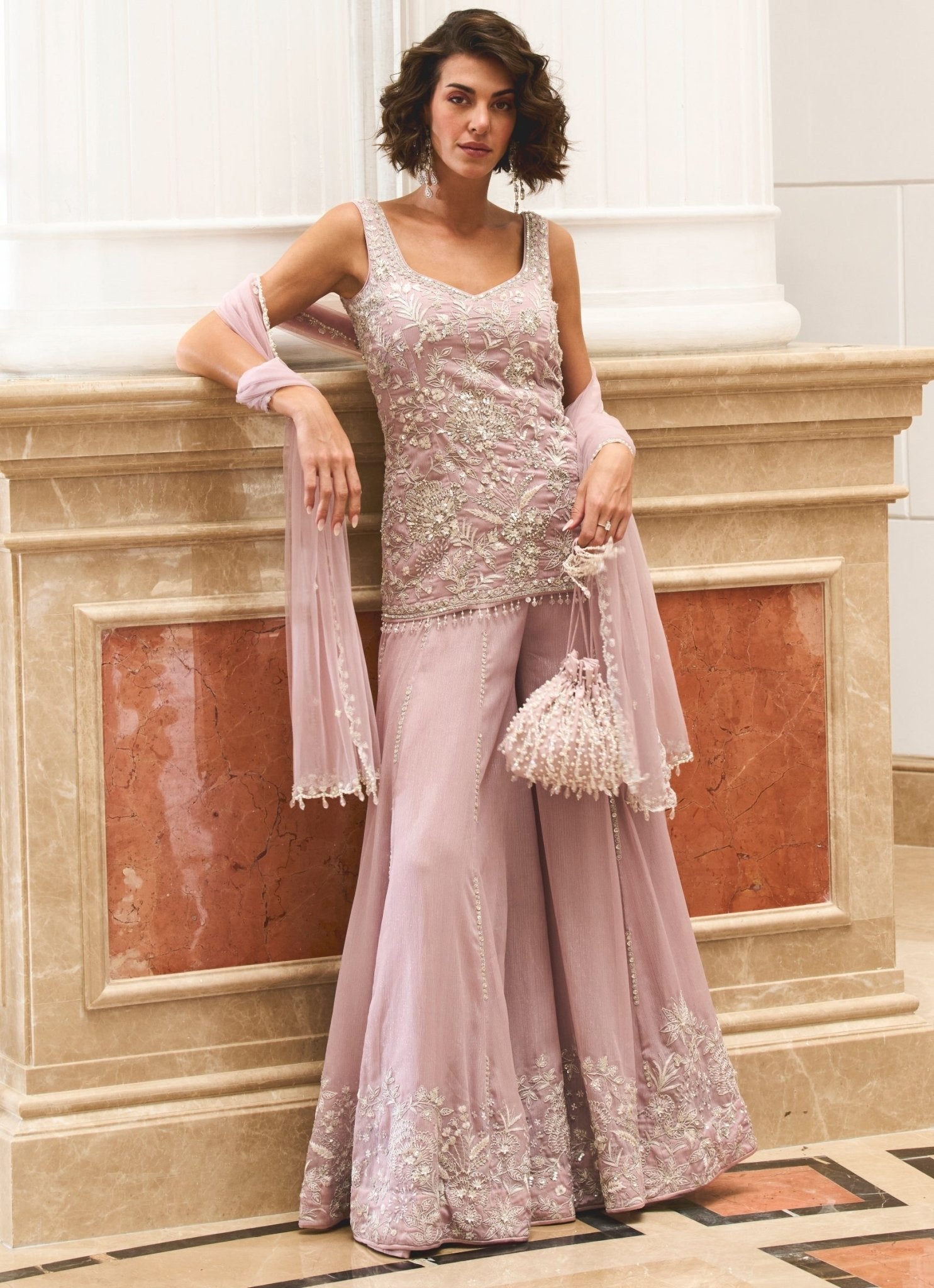
Cocktail soft
Lilac embroidered shimmer georgette — softer evening palette for cocktail receptions and wedding guest appearances where you want to be celebratory without competing.
Sharara for the Wedding Day Itself: Pure Silk, Considered Embroidery
When you are the centre of attention — whether as the bride or the closest family — the sharara should rise to the occasion. The fabric weight changes, the embroidery becomes denser, and the colour palette moves toward the colours traditionally associated with the wedding day. Pure silk tissue, with its faint metallic sheen and structured drape, is one of the most ceremonial fabrics in the sharara tradition. Hand embroidery on a piece of this weight is what separates a bridal sharara from a guest sharara — and what makes it a piece you keep in the wardrobe for decades rather than seasons. Browse the broader destination wedding sharara collection for pieces with the same wedding-day weight and travel-friendly construction.
Bridal weight
Ivory and gold embroidered pure silk tissue — the fabric weight and embroidery density that separate a wedding-day sharara from a guest piece.
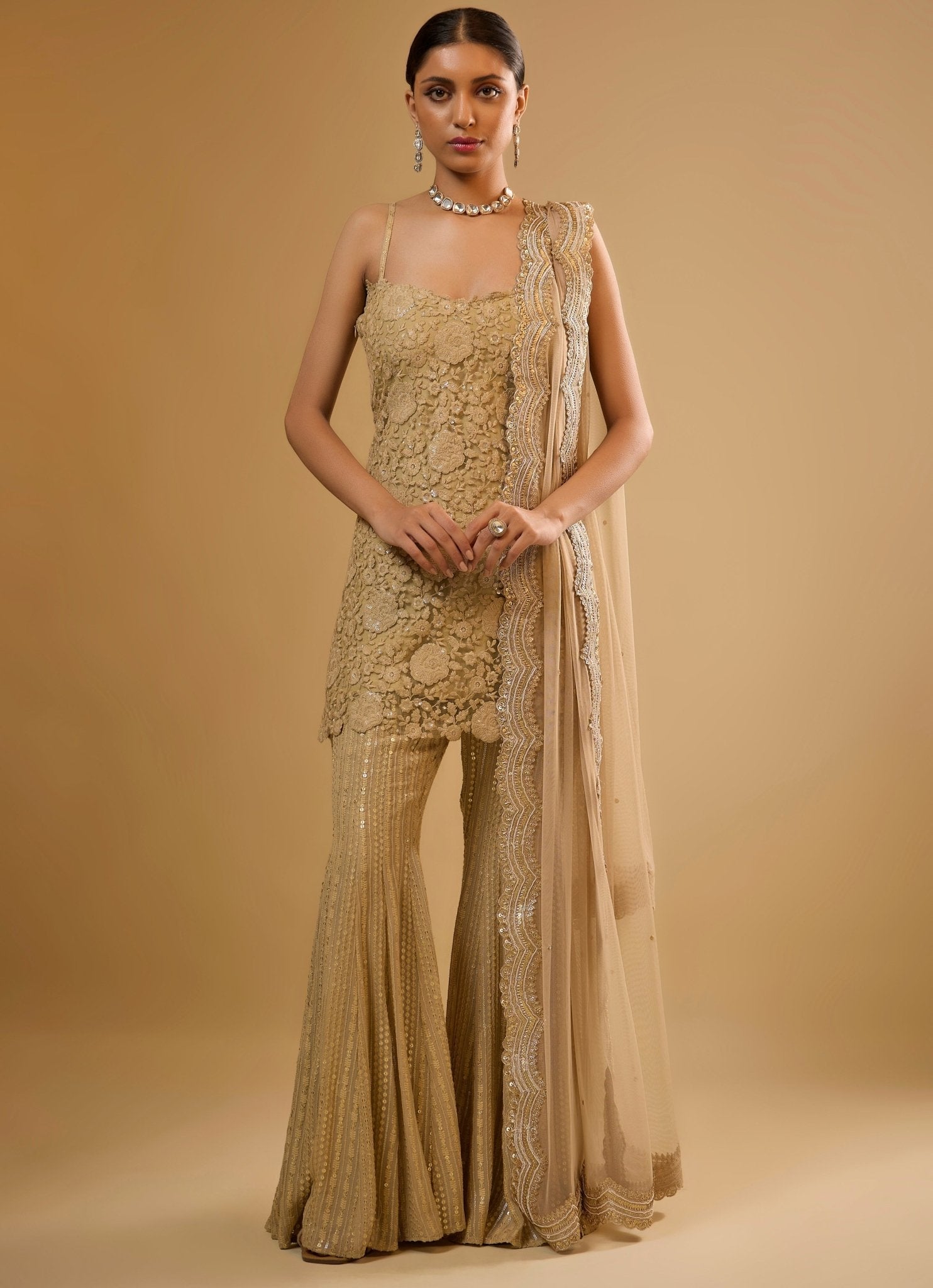
Reception gold
Gold net kurta sharara — a softer take on bridal weight, suited to nikah, reception, and the close-family moments of a multi-day wedding.
How to Style a Sharara Well
A few editorial notes from years of dressing for South Asian occasions. Footwear should disappear, not announce. A heeled mojari, a closed-toe pump, or a delicate strappy heel keeps the silhouette long. Avoid chunky platforms — the sharara wants to flow uninterrupted. Let the outfit lead the jewellery. A heavily embellished kurta calls for restrained earrings and perhaps a single statement piece — a maang tikka or a kada. A simpler sharara invites a fuller jewellery moment.
The dupatta drape is a styling decision, not an afterthought. A single-shoulder drape with the fall pinned at the waist reads modern. A double-shoulder drape reads ceremonial. A veil drape over the head is reserved for the most formal religious moments. Trust the tailoring. A well-fitted sharara hits the floor cleanly, sits flat at the waist, and allows movement at the hip — which is why made-to-measure construction is worth the wait for any serious occasion piece.
Why Custom Sizing Matters for Sharara Suits
Of all the silhouettes in the South Asian wardrobe, the sharara is perhaps the least forgiving of off-the-rack sizing. The waist must sit precisely; the flare must begin at exactly the right point on your leg; the length must fall correctly relative to your heel height.
At Fabilicious, we offer made-to-measure construction with a video-call consultation for measurements, so the piece arrives built for you rather than approximated. The pairing of South Asian craftsmanship — the karigars, the embroiderers, the tailors whose work this tradition relies on — with European quality control means each sharara is checked thoughtfully before it leaves us.
FAQ
What is a sharara suit?
A sharara suit is a three-piece South Asian ensemble consisting of a kurta (tunic), wide-legged flared trousers that fall from the knee or thigh, and a dupatta. It originated in the courts of Awadh in the eighteenth century and is now favoured by brides, wedding guests, and modern occasion-wear customers for its combination of romantic silhouette and ease of movement.
What's the difference between a sharara, a gharara, and a lehenga?
A lehenga is a long flared skirt with a separate blouse. A gharara has trousers fitted to the knee then released into a heavily pleated lower section joined by an ornate horizontal band — the most ceremonial of the three. A sharara has trousers that flare smoothly from the upper thigh or knee, paired with a longer kurta, giving it a softer line that sits between the other two.
Can a sharara suit be worn as a wedding guest?
Yes — the sharara is one of the most versatile wedding guest silhouettes. Lighter fabrics in georgette or shimmer suit daytime functions like mehendi and haldi, while embellished jewel tones work for sangeet and cocktail evenings. Avoid ivory, gold, and full bridal red unless the bride has explicitly invited those colours.
Is a sharara suit easier to wear than a lehenga?
For most occasions involving movement — dancing at a sangeet, walking through a long ceremony, navigating a destination wedding — yes. The trouser construction means there is no skirt hem to manage, and the silhouette stays clean throughout the day. A lehenga is more dramatic when standing still; a sharara is more practical in motion.
Where can I buy a custom-fitted sharara online?
Fabilicious offers made-to-measure sharara suits with video-call measurement consultations, shipping internationally from Denmark with European quality control. Browse the full sharara collection or our wedding guest sharara edit for curated pieces.
Shop the Sharara Collection
- Curated sharara suits from designers like Sanya Gulati, Esha Koul, Chamee and Palak, and Renee Label
- Made-to-measure construction with video-call fit consultations
- International shipping with European quality control


Leave a comment