

His and Hers: Coordinated Wedding Outfits

His and hers in Juhi Bengani — the coordinated couple silhouette for Indian weddings in 2026.
The coordinated couple look has shifted considerably in the last two seasons. Where matching outfits once meant identical fabrics, matching colours, and a feeling closer to costume than to occasion wear, the 2026 version of his and hers is built on something more disciplined — palette harmony rather than literal matching, complementary silhouettes rather than mirrored ones, and the kind of editorial restraint that lets each partner's piece read as a designer look on its own first. The result is what most modern couples are actually after: photographs that show two people clearly dressed together without either look being subsumed by the other.
This guide walks through how to build a coordinated his-and-hers look for an Indian wedding in 2026 — function by function, with paired pieces worth knowing. The work doing the most for this brief right now comes from Juhi Bengani, whose menswear and womenswear collections share a design language without copying each other — meaning the pieces coordinate without trying to.
The Three Rules of Modern His-and-Hers Dressing
Coordinate the palette, not the pieces. The strongest couple looks share a colour story but use different silhouettes within it. A lilac printed kurta with a lilac printed pre-draped saree reads as a couple dressing together. A lilac kurta with a lilac kurta on the woman reads as a costume. The discipline is to pick a palette and trust each partner to interpret it in their own silhouette.
Match the formality, not the embellishment. If one partner is in a heavily embellished piece, the other should be in equally formal construction — not necessarily equally embellished. A bridal-weight embroidered corset paired with a simple but well-cut solid silk kurta on the partner reads as deliberate. A heavily embellished womenswear piece paired with a casual men's kurta reads as mismatched.
Each piece should stand alone. The test of a strong his-and-hers look is whether each partner's outfit would read as a considered designer piece if photographed individually. If either look depends on the other to make sense, the coordination has tipped into costume.
His and Hers for the Mehendi: Daytime, Printed, Coordinated
The mehendi sits at the daytime end of the wedding calendar, with outdoor settings, natural light, and the most photographed seated portraits of the wedding. The couple look for this function should read fresh — confident prints, lighter fabrics, and a colour story that holds together under daylight without being identical. The pairing below uses navy and orange as the unifying palette across distinctly different silhouettes — a printed organza corset lehenga on her, an embroidered satin kurta set on him. The coordination sits in the shared palette and the equally considered construction; the pieces themselves are nothing alike.

His — mehendi
Navy blue embroidered satin kurta pants set — structured daytime menswear with embroidery considered enough to hold its own against the printed lehenga on her.
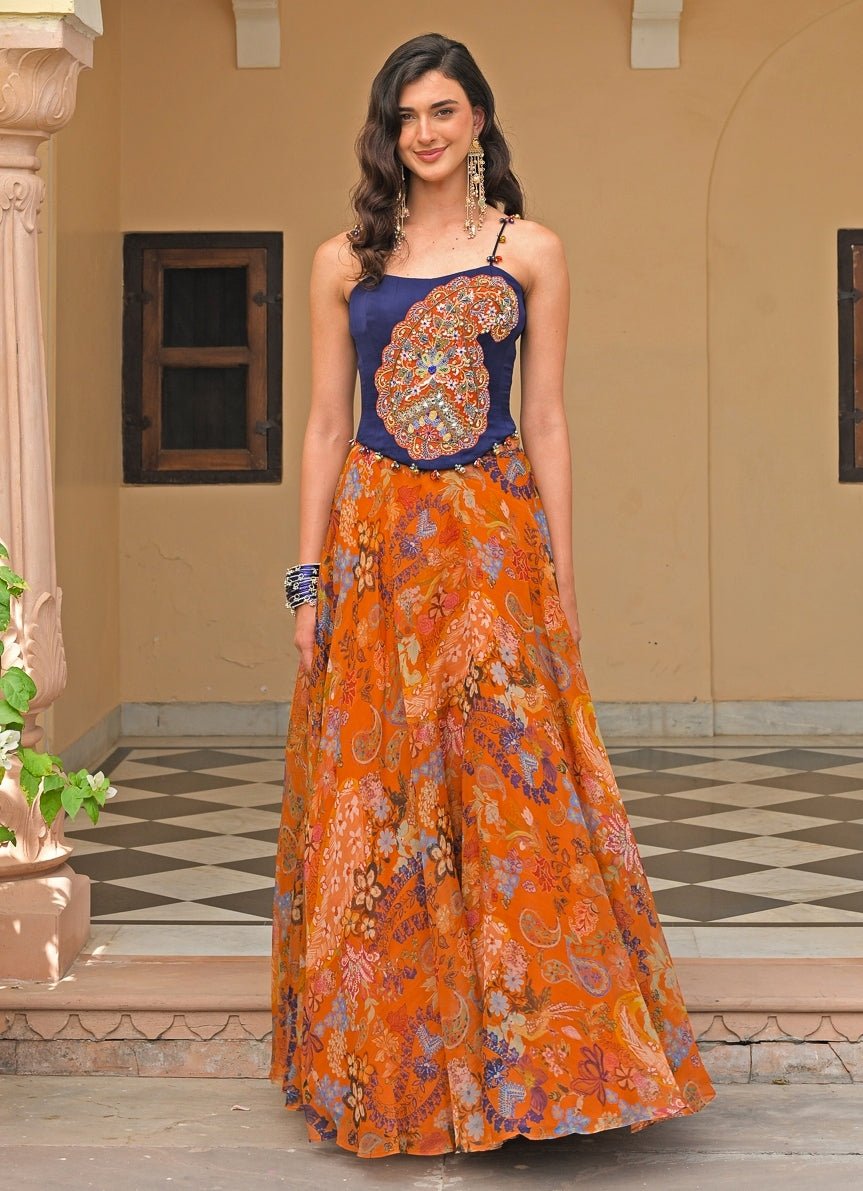
Hers — mehendi
Orange and blue organza corset lehenga set — printed organza skirt with a corset construction that reads modern, in a navy-and-orange palette that ties to the menswear without copying it.
His and Hers for the Sangeet: Lilac on Lilac, Done Right
The sangeet is where coordinated couple dressing earns its strongest editorial moment. The ambient lighting, the photographed performances, the choreographed entrances — all of it rewards couples who have thought through how they read together on camera. The pairing below uses lilac as the unifying colour across two distinctly different silhouettes — a printed organza kurta set on him, a printed chinon pre-draped saree on her. The shared print discipline carries the coordination; the corset on her reads as eveningwear, the kurta on him reads as eveningwear, and together they photograph as a considered couple rather than as a matched pair.

His — sangeet
Lilac printed organza kurta pants set — the menswear interpretation of the shared print story, in a softer evening palette that suits sangeet ambient lighting.
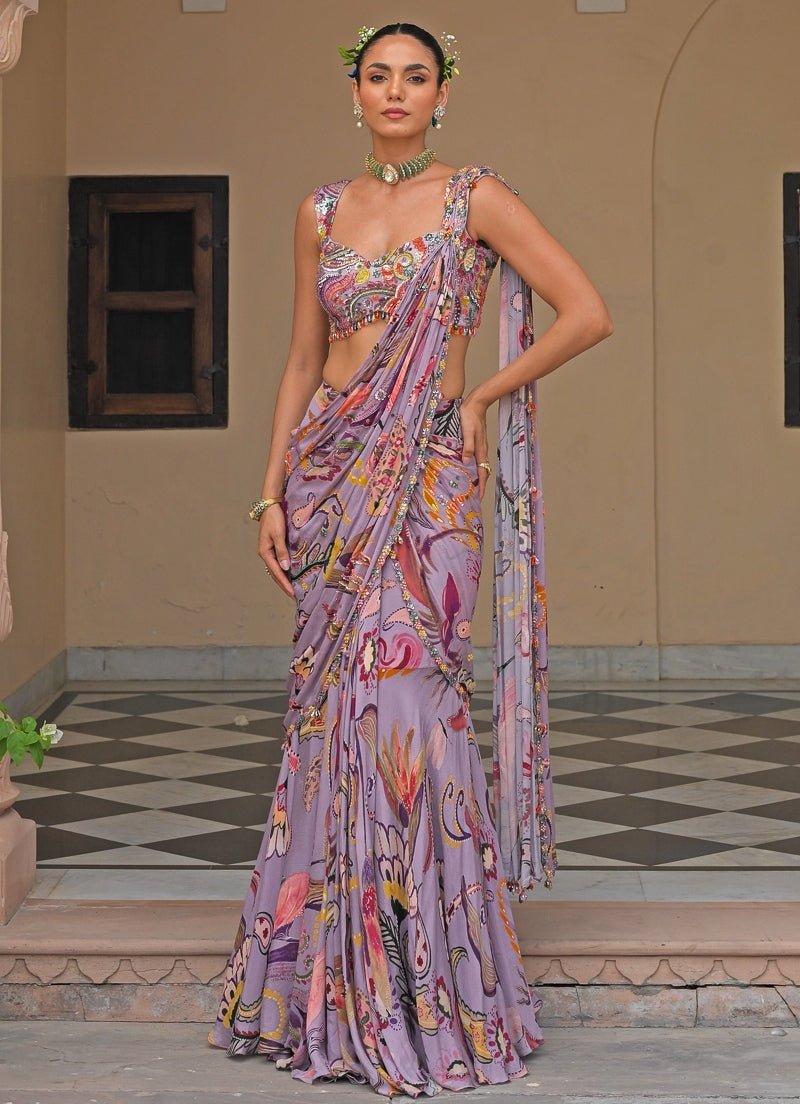
Hers — sangeet
Lilac printed chinon pre-draped saree — pre-stitched drape with a corset blouse, in a shared lilac print that ties cleanly to the menswear without being identical.
His and Hers for the Roka: Red on Red, Editorial and Restrained
The roka — the formal engagement function — is where coordinated couple dressing has the strongest cultural precedent and the most considered modern treatment. Red is the traditional palette for the function, but the 2026 version of red-on-red is editorial rather than literal — embellishment placed with intent, fabric weights chosen to complement each other, and silhouettes that read as eveningwear first. The pairing below uses red satin organza across a kurta set for him and a corset saree for her, with the same designer language carrying both pieces. The result is the kind of coordinated look that photographs as deliberate rather than accidental.

His — roka
Red embroidered satin organza kurta pants set — formal-weight menswear in the traditional roka palette, with embroidery placed to read editorial rather than ceremonial.
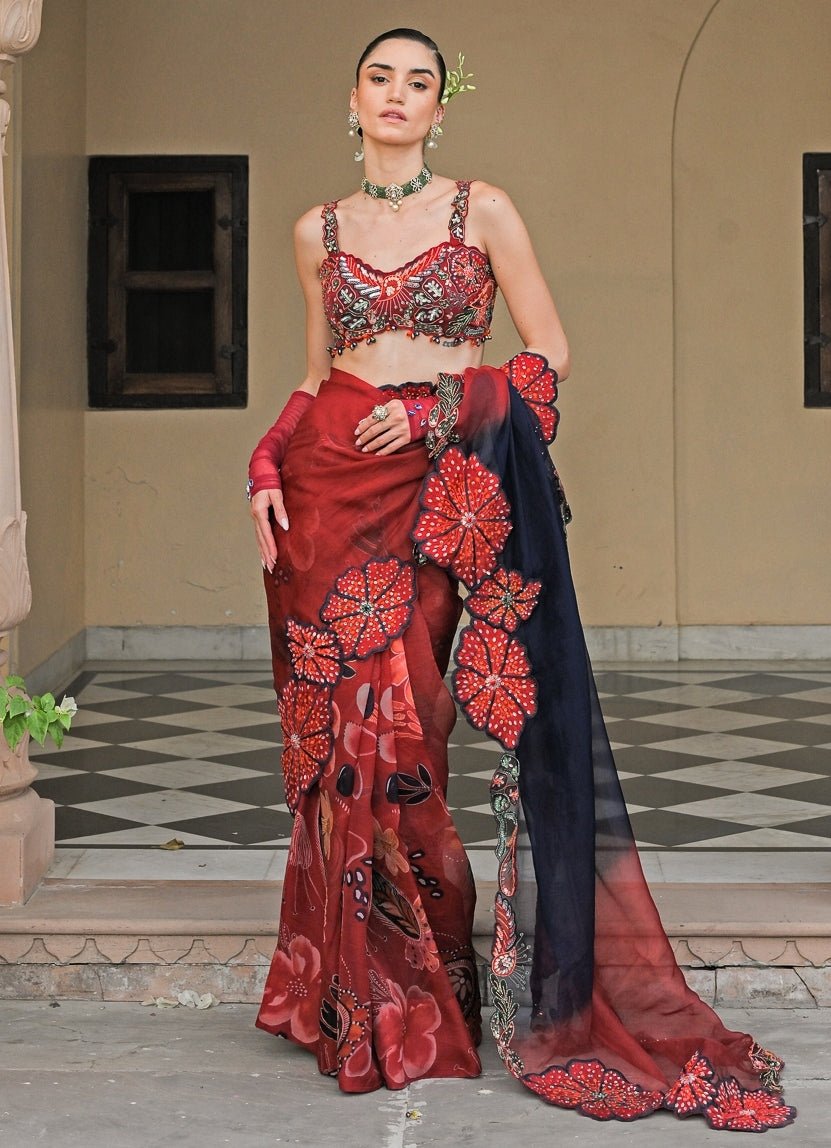
Hers — roka
Red and black organza saree with corset — eveningwear-weight corset construction in the same red palette, with black detailing that gives the piece an editorial dimension beyond traditional roka dressing.
Why Juhi Bengani Has Become the Designer for Coordinated Couple Looks
Building a his-and-hers look across two different designers is harder than it looks — fabric weights vary, embroidery languages clash, and prints rarely line up cleanly across menswear and womenswear collections. Juhi Bengani has built her men's and women's collections around a shared design vocabulary, which means the pieces coordinate without needing to match. The prints reference each other. The embroidery languages are consistent. The fabric weights complement rather than compete.
For couples building wedding wardrobes across multiple functions — engagement, mehendi, sangeet, ceremony, reception — this consistency matters disproportionately. Pieces ordered separately for different events still photograph as the same couple, in the same wardrobe, across the entire wedding calendar. For a fuller breakdown of her womenswear specifically, our Juhi Bengani 2026 collection guide covers her broader range; the men's kurta sets guide covers her menswear in depth.
How to Style His and Hers Well
A few editorial notes from years of dressing couples for South Asian weddings.
Decide on the palette before you order either piece. The strongest couple looks start with a shared colour story — lilac, jewel green, navy and orange, red on red — and let each partner pick a silhouette within it. Ordering pieces independently and then trying to coordinate after the fact rarely works.
Match the function, not the formality of each other's piece. If the woman is in a heavily embellished corset and the man is in a simple solid kurta, the look reads imbalanced even with a shared palette. Both pieces should sit at the same formality level for the function being attended.
Footwear should coordinate, not match. If she is in a closed-toe heel, he should be in polished loafers or mojaris — same level of formality, different silhouette. Mismatched footwear formality is one of the most common couple-look mistakes.
Photograph together before the function. If you have the pieces in advance, take a phone photograph standing next to each other in good light. The discrepancies that are invisible in the mirror become obvious in a photograph — and the function will be photographed regardless of whether you tested it first.
Why Choose Fabilicious for His and Hers Looks
Fabilicious is one of the longest-standing international stockists of Juhi Bengani's menswear and womenswear collections — meaning we know which pieces coordinate well across both ranges and can advise on building a couple wardrobe rather than just two separate orders.
Customers across the US, UK, Canada, and Australia routinely book a video-call consultation for couple orders, where we measure both partners and confirm the pieces work together before construction begins. Every piece ships with made-to-measure support, alteration coverage, and European quality control layered on top of South Asian craftsmanship.
FAQ
What is the difference between matching and coordinated couple outfits?
Matching outfits use the same fabric, colour, and often the same print across both partners. Coordinated outfits share a palette and design language but use different silhouettes — for example, a lilac printed kurta for him and a lilac printed pre-draped saree for her. Coordinated is the contemporary preference; matching reads closer to costume.
Should couples wear the exact same colour to an Indian wedding?
Not necessarily — and often it works better when they don't. Sharing a palette (lilac and lavender, or navy and blue, or red and oxblood) is stronger than matching exactly. The eye reads the harmony without registering the pieces as identical, which is the modern editorial preference for couple dressing.
Which designer is best for his and hers Indian wedding outfits?
Juhi Bengani is currently the designer doing the most considered work in coordinated couple dressing, with menswear and womenswear collections built around a shared design vocabulary. The pieces coordinate without needing to match, which is precisely the brief for a modern his-and-hers look.
Can couples wear his and hers as wedding guests, or is it only for the bride and groom?
Both — coordinated couple dressing has become increasingly common for wedding guests, particularly for sangeet and reception functions. The same principles apply: share a palette, match the formality, avoid bridal colours like red, ivory, or full gold for the ceremony unless explicitly invited.
How early should couples order his and hers outfits for an international wedding?
Allow at least 6 to 8 weeks before the wedding date if shipping to the US, UK, Canada, or Australia. Couple orders benefit from a joint video-call consultation where both partners are measured together and the pieces are confirmed to coordinate before construction. For heavily embellished pieces specifically, build in 8 to 10 weeks where possible.
Shop Juhi Bengani His and Hers
- Coordinated menswear and womenswear from Juhi Bengani's 2026 collection
- Made-to-measure construction with joint video-call fit consultations
- International shipping to the US, UK, Canada, and Australia


Leave a comment